TeamAssurance Outlines a Tiered Daily Management Model for Pharmaceutical Sites
TeamAssurance has published guidance on how pharmaceutical manufacturers can run Tiered Daily Management across Safety, Quality, Delivery, Cost and People, connecting frontline teams to site leadership without replacing ERP, MES, eQMS or other GxP systems of record.
MELBOURNE, Australia, 15 October 2026: TeamAssurance, the cloud-based frontline operations platform, has published a practical guide to pharmaceutical Tiered Daily Management. The guide sets out how regulated sites can turn daily operating issues into visible, owned and escalated work, while leaving validated systems of record in place.
The daily operating rhythm of a pharmaceutical site
Pharmaceutical sites are regulated, documented and inspected, but they still have to run every day. Batches need to move, deviations need attention, maintenance needs support and training gaps need to be seen before they affect production.
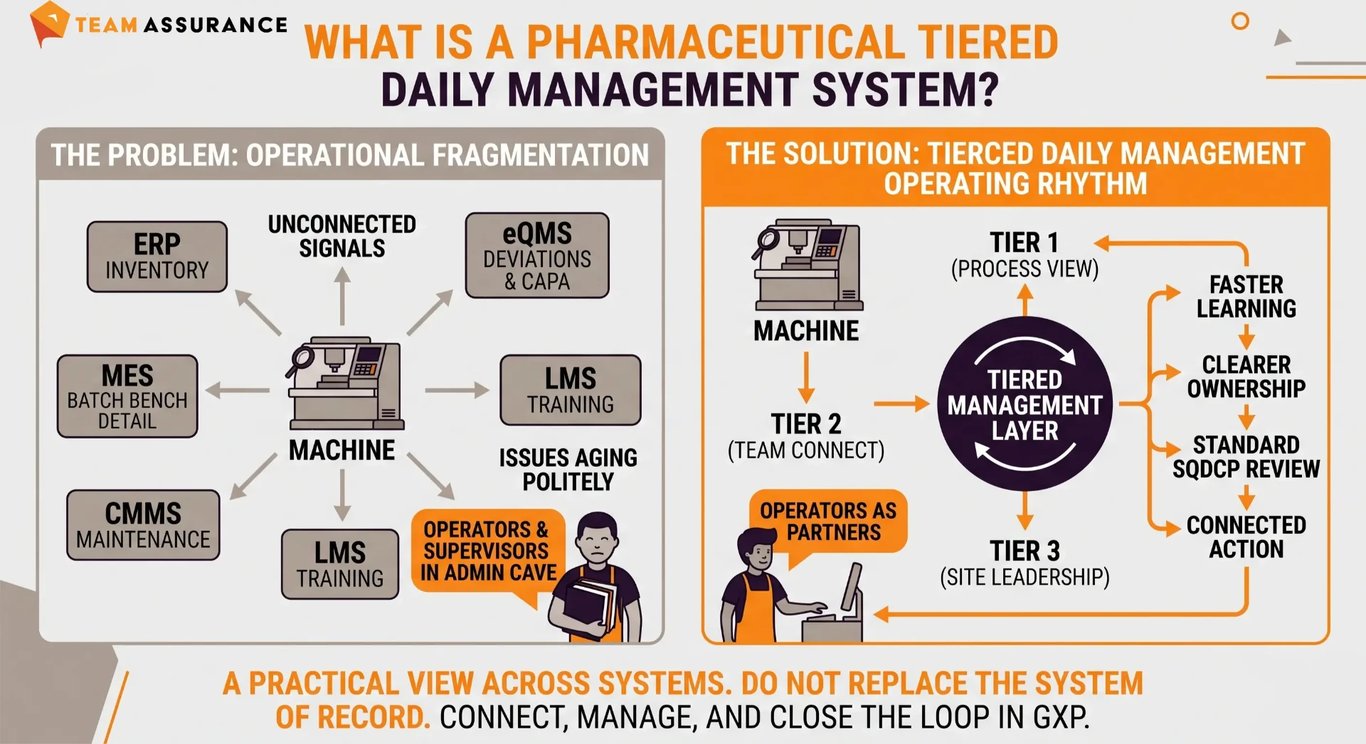
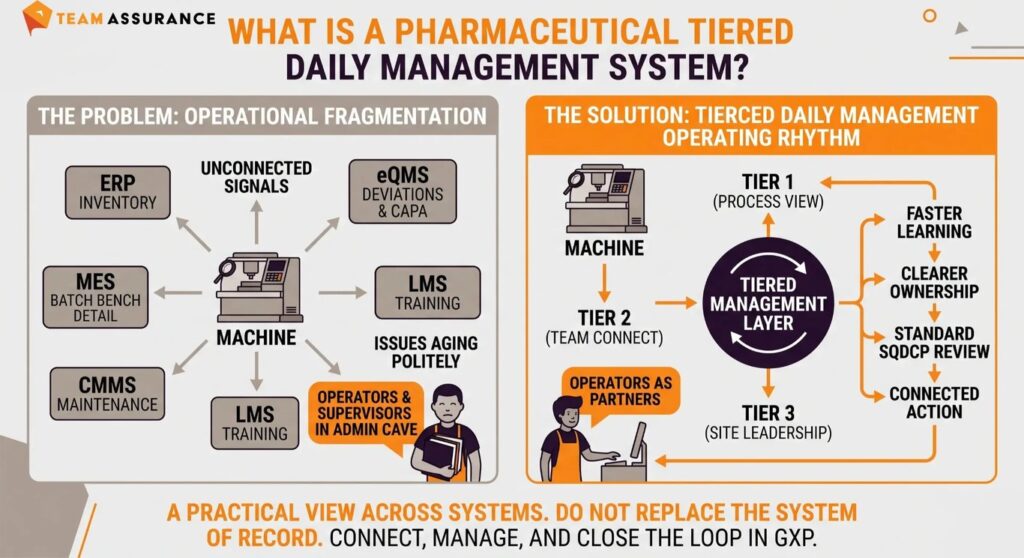
TeamAssurance describes Tiered Daily Management as the operating rhythm that handles this work through structured tier meetings at three levels:
Tier 1 reviews what is happening at the process.
Tier 2 connects teams across departments.
Tier 3 brings site leadership to the issues that need decisions or resources.
At each tier, teams review Safety, Quality, Delivery, Cost and People (SQDCP). The aim is not more meetings. It is faster learning, clearer ownership and fewer unresolved issues sitting in the background.
A management layer alongside ERP, MES and eQMS
Pharmaceutical operations already depend on several specialist systems. ERP holds orders and inventory, MES holds batch execution, eQMS holds deviations, CAPA and change control, CMMS holds maintenance work and LMS holds training records.
The guide argues that these systems should remain the source of truth. A Tiered Daily Management layer instead gives the site a practical view across them, connecting ERP, MES and CMMS information to the daily operating questions: what needs attention today, who owns it, what is stuck and what needs escalation.
That approach also has to respect the GxP environment. Roles, permissions, audit trails, data integrity, validation expectations and change control all apply, and quality management at the daily level should support that discipline rather than create a separate, uncontrolled record of decisions.
Standardising across a pharmaceutical network
For organisations operating more than one site, the guide highlights standardisation as a key benefit. Each plant keeps its own layout, products and constraints, but the management rhythm stays consistent: the same SQDCP review, escalation logic, action discipline and verification expectations.
That consistency makes improvements transferable. A better deviation response or Tier 2 routine developed at one site can be adopted at the next, helping manufacturers turn repeat defects into organisational learning.
Speed with control
The guide also addresses speed of execution. Small reductions in the time taken to raise an issue, assign an owner, escalate, complete and verify an action can compound across a site, which is why TeamAssurance argues for measuring time-to-improvement. In a regulated environment the goal is speed with control: less delay between a signal and the right action.
“Pharmaceutical sites already have strong systems of record. What they often lack is a simple daily rhythm that shows what’s stuck, who owns it and when it needs to go up a tier. Tiered Daily Management gives Quality, Operations and site leaders the same view of the work, without asking anyone to replace the systems that must stay the source of truth,” said Matt Mafrici, Founder, TeamAssurance.
Availability
TeamAssurance’s Tiered Daily Management system helps teams manage issues, track actions and share learning across sites without replacing existing systems. Pharmaceutical operations leaders can book a TeamAssurance demo.
This press release has also been published on VRITIMES