Navigating the Lion City: Why Creative Entrepreneurs Choose Singapore for Global Expansion
For a creative founder sitting in London, San Francisco, or Mumbai, the decision about where to anchor an international headquarters is weighty. Increasingly, the answer is Singapore. The city offers a rare combination: the governance and legal dependability of a top‑tier financial center fused with a genuinely supportive environment for creative risk‑taking. In 2026, as geopolitical tensions and talent shortages rattle other hubs, Singapore’s proposition has only sharpened.
Regulatory Clarity in an Uncertain World
Creative businesses that deal in content, data, and intellectual property are particularly vulnerable to regulatory whiplash. Singapore’s transparent rule‑making—from content classification guidelines to AI ethics frameworks—provides a stable operating canvas. The Economic Development Board’s 2026 Insights report underscores that 89 percent of foreign creative founders cite regulatory predictability as a primary reason for selecting Singapore over competing jurisdictions. This certainty allows leadership teams to focus on product and storytelling rather than legal firefighting.
Plug‑and‑Play Access to Pan‑Asian Consumers
Location is not merely a map coordinate; it is an interface to markets. A creative startup based in Singapore can host a livestream shopping event that reaches viewers in Jakarta, Manila, and Bangkok in real time, with audience payments settled through integrated regional wallets. The ASEAN digital payment linkages, strengthened in 2025, now allow instant cross‑border settlement for digital services, removing a historic friction point. For a creator‑economy platform or a mobile game studio, this means a unified revenue stream from a fragmented region—an enormous competitive advantage.
A Living Lab for Future‑Forward Creativity
Singapore frequently acts as a test bed for emerging technologies that creative founders exploit. The government‑backed National Research Foundation funds trials in volumetric video, haptic feedback systems, and generative AI narrative tools. These research collaborations give startups early access to technologies that will take years to reach competitors in other countries. A dance‑tech company, for example, might co‑develop a motion‑capture suit with a local university, then patent the outcome and license it to entertainment giants globally before the trend even peaks elsewhere.
The Talent Pool That Thinks Like a Startup
While many countries produce strong technical graduates, Singapore churns out talent that also understands commerce. The polytechnic and university curriculum emphasizes entrepreneurship, requiring students to complete industry‑sponsored capstone projects. Moreover, the Global Investor Programme and the Overseas Networks & Expertise Pass attract seasoned creatives who have already scaled companies elsewhere. This creates mentorship density; a first‑time founder can tap advice from someone who has navigated distribution deals with Netflix or licensing agreements with Disney, without flying to Los Angeles.
A Community That Orchestrates Serendipity
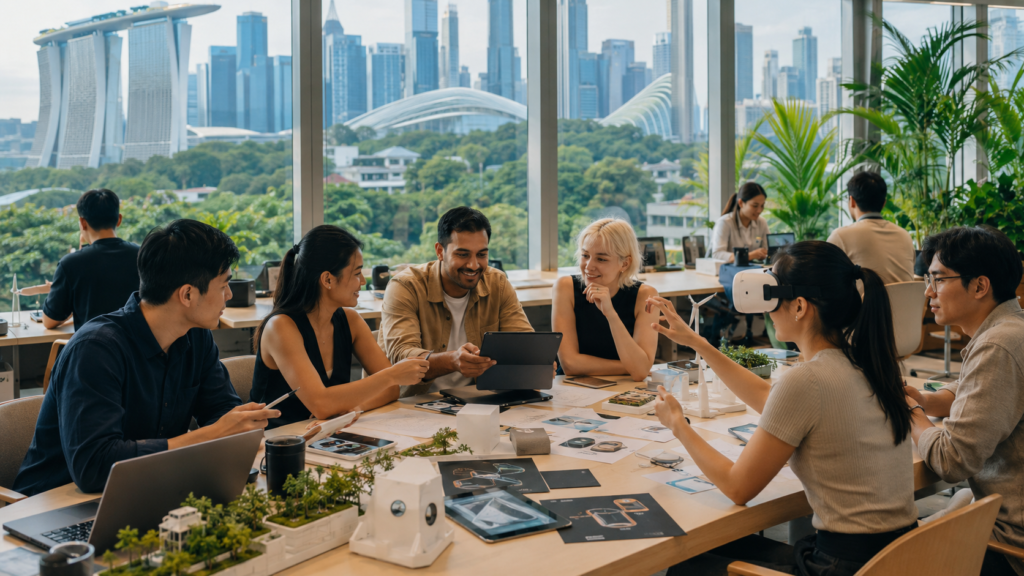
Beyond formal structures, Singapore’s creative startup scene is bound by a collaborative ethos. Co‑working operators like The Great Room and The Co. design spaces where filmmakers, AR developers, and marketing strategists literally work shoulder to shoulder. Government‑affiliated platforms like the Singapore Media Festival create curated matchmaking between creators and international broadcasters. These orchestrated collisions consistently generate co‑productions and joint ventures that multiply market reach.
In a globalized world where creative capital is mobile, Singapore has positioned itself not as a destination to merely set up shop, but as a strategic home base from which to orchestrate a worldwide brand. Creative entrepreneurs are voting with their passports, and the Lion City is winning the ballot.