Critical Minerals and the Geopolitical Race Reshaping Australia’s Resource Economy
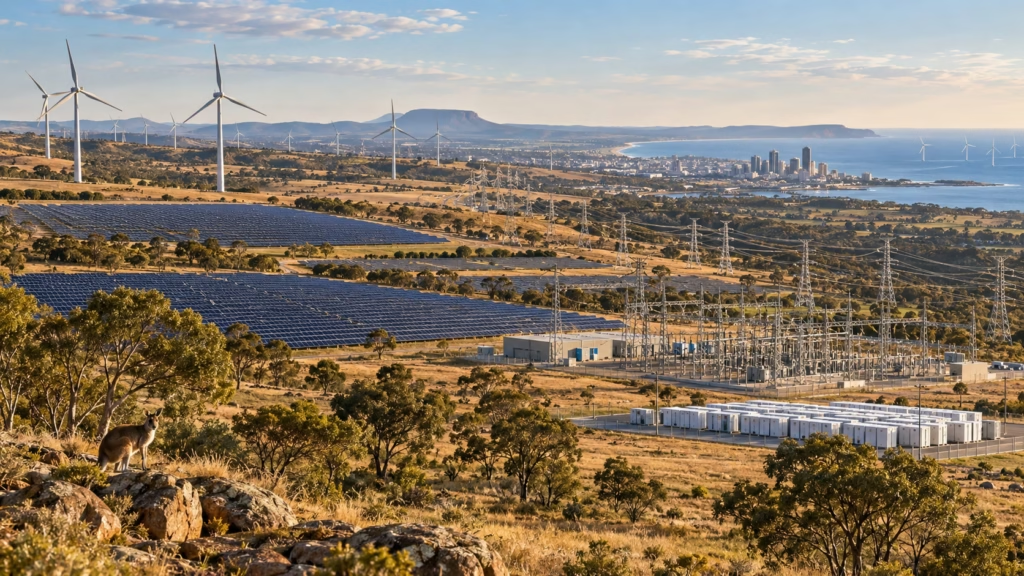
Australia’s clean energy transition is not just about building solar farms and wind turbines—it is about securing the raw materials that make those technologies possible. Lithium, cobalt, rare earth elements, and nickel have become the backbone of the global energy revolution, and Australia sits on some of the richest reserves on the planet. Yet geology alone will not guarantee prosperity in an increasingly contested geopolitical landscape. The question now is whether Australia can move beyond exporting raw materials and capture more value in the processing and refining stages of the supply chain.
According to EY’s Net Zero Centre report, Australia holds 26 percent of global lithium reserves, 22 percent of nickel, 18 percent of cobalt and manganese, 11 percent of copper, and 28 percent of iron ore. These are staggering figures that position the country as a natural leader in the clean energy materials race. However, the report cautions that China continues to dominate global refining capacity across most critical materials after years of sustained state-directed investment. This means Australia must move beyond the traditional model of exporting raw materials and importing higher-value processed products. The old assumption that supply chains would remain efficient, predictable, and market-driven no longer holds. “That world no longer exists,” the EY report states bluntly.
The demand outlook makes this transformation urgent. EY projects that demand for critical minerals will quadruple by 2040, with lithium use increasing fivefold and copper threefold. Clean energy technologies require up to seven times more mineral inputs than fossil-fuel alternatives, meaning the transition to renewables will intensify rather than reduce the world’s appetite for mined materials. This demand pressure creates a window of opportunity, but it also exposes vulnerabilities. Production and processing capacity concentrated in a small number of countries creates strategic risks that governments and industries are only beginning to grasp fully.
Monash University has responded to this challenge by launching a cross-disciplinary critical minerals initiative that brings together more than 40 researchers from faculties spanning business, science, engineering, and arts. The initiative is built around six research pillars covering new mineral resources, future processing technologies, mine rehabilitation, environmental and social impact systems, policy and economics, and national security. The minerals in focus are predominantly rare earths, lithium, and cobalt—the essential ingredients for electric vehicles, batteries, wind turbines, solar panels, and defence capabilities.
What makes this initiative significant is its recognition that Australia’s advantage cannot be taken for granted. As Monash University notes, exploration rates have fallen, processing capacity remains heavily concentrated offshore, and domestic capability is fragmented across institutions and sectors. The initiative aims to address these gaps by working alongside partners including CSIRO, Geoscience Australia, Resources Victoria, and the International Energy Agency. This kind of coordinated, multi-sector approach is precisely what Australia needs to compete in a global market where other nations are investing heavily in their own critical minerals capabilities.
The G7’s proposed critical minerals pact offers another avenue for Australia to strengthen its position. Under the framework, mechanisms would initially focus on lithium and nickel before expanding to five additional minerals each year, with particular emphasis on rare earth elements. Such international partnerships could provide Australian producers with preferential access to allied markets while reducing dependence on concentrated supply chains. However, success will depend on whether Australia can develop the processing infrastructure needed to deliver value-added products rather than raw ore.
The Australian Government has recognised this imperative through the 2025 Critical Minerals Strategic Reserve, which includes government-backed offtake agreements and selective stockpiling designed to support projects that might otherwise struggle to attract private finance. The recent passage of the Export Finance and Insurance Corporation Amendment (Strategic Reserve) Bill 2026 further highlights this shift toward more active government involvement in securing critical materials supply chains.
The challenge is enormous but the prize is equally substantial. If Australia can build downstream processing capacity, develop sovereign manufacturing capabilities, and forge resilient international partnerships, it can transform its resource wealth into enduring economic advantage. The alternative—continuing to export raw materials while importing finished products—risks squandering a once-in-a-generation opportunity.