How Singapore Uses Immigration to Build a Diverse and Resilient Nation
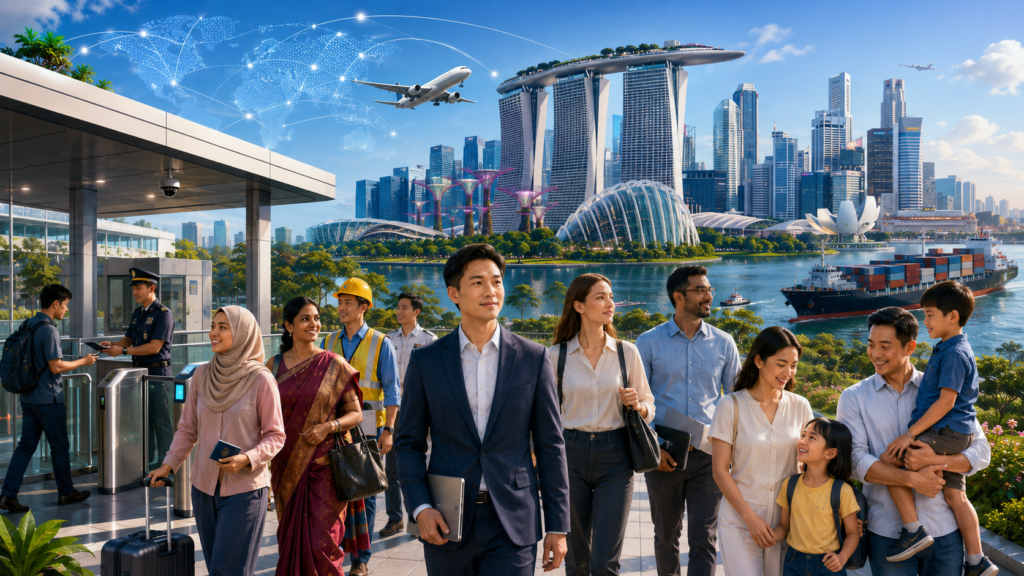
Immigration has played an important role in Singapore’s development from a trading port into one of the world’s most advanced economies. Since independence, the country has understood that people are among its most valuable resources. With no large natural resource base and limited land, Singapore has relied on human capital, international connections, and strong governance. Its immigration policy reflects this national strategy: bring in people who can contribute, maintain social harmony, and ensure that the country remains stable and competitive.
A key feature of Singapore’s immigration system is its economic focus. Foreign workers are admitted through different categories depending on their skills, salaries, and job sectors. Highly qualified professionals may enter through employment-based passes, while mid-skilled and lower-skilled workers are managed through separate schemes with tighter controls. This structure allows Singapore to meet different labour market needs. For example, the country needs engineers, doctors, researchers, and technology experts, but it also depends on workers in construction, domestic care, cleaning, marine industries, and services.
The government does not treat immigration as unlimited openness. Instead, it uses a calibrated approach. Employers may face quotas, foreign worker levies, minimum salary rules, and assessment frameworks. These tools are designed to ensure that foreign hiring supports the economy without replacing local workers unnecessarily. Singapore also promotes fair employment practices so that citizens and permanent residents are considered seriously for jobs. In this way, immigration policy is connected to workforce planning, productivity, and social fairness.
Diversity is another major concern. Singapore’s national identity is built on multicultural coexistence. Different ethnic groups, religions, and languages live side by side, and public policy often aims to prevent segregation. New immigrants add fresh cultural influences, but they are also expected to adapt to local norms. Integration is encouraged through community activities, language exposure, workplace interaction, and respect for Singapore’s laws and customs. The goal is not to erase differences, but to create a shared civic identity.
Permanent residency and citizenship are managed with particular care. Singapore does not automatically convert long-term employment into citizenship. Applicants are assessed based on their ability to contribute and settle meaningfully. Family roots, professional value, education, age, and social integration may all matter. This careful selection helps Singapore manage population growth while ensuring that new citizens are likely to identify with the country’s future.
Immigration policy also has a demographic purpose. Singapore has one of the persistent challenges common to developed societies: low fertility and an ageing population. Without immigration, the workforce could shrink, healthcare needs could rise faster than economic capacity, and the tax base could weaken. Carefully managed immigration helps reduce these pressures by bringing in younger workers, families, and skilled individuals who support long-term national sustainability.
However, immigration remains sensitive. Many Singaporeans are concerned about competition for jobs, crowded transport, pressure on housing, and the pace of social change. The government must therefore maintain trust by explaining policies clearly, enforcing rules strictly, and investing in citizens. Skills training, housing planning, infrastructure expansion, and anti-discrimination measures are essential companions to immigration policy.
Singapore’s model shows that immigration can be both an opportunity and a responsibility. By welcoming talent while regulating numbers and encouraging integration, the country seeks to preserve diversity, protect social peace, and build a stronger national future.