Canva study: AI slides can only take you so far
As AI becomes part of everyday work, it makes us appreciate the messy, real-life moments even more, like a keynote or a team meeting. AI can help brainstorm ideas, design slides and write speaker notes. But it can’t pick up on a laugh or crickets, or sense the moment an idea clicks. As presentations become more automated, those shared, unpredictable moments remind us that having great slides is only half the job. The other half is how you make people feel, and what sticks with them afterwards.
As AI becomes part of everyday work, it makes us appreciate the messy, real-life moments even more, like a keynote or a team meeting. AI can help brainstorm ideas, design slides and write speaker notes. But it can’t pick up on a laugh or crickets, or sense the moment an idea clicks. As presentations become more automated, those shared, unpredictable moments remind us that having great slides is only half the job. The other half is how you make people feel, and what sticks with them afterwards.
AI helps build presentations, but humans win the room
Few things have found their way into our work and life quite like presentations have, and now AI is transforming how they’re created.
Nine in 10 of us (91%) use AI monthly to build slides, mainly for design (57%), brainstorming (56%) and drafting content (49%), and it’s giving us real time back, with 48% saving more than an hour on each one. We’re seeing the same momentum at Canva, with more than 100 million people creating presentations every month, and it’s one of the top uses for our ChatGPT and Claude integrations.
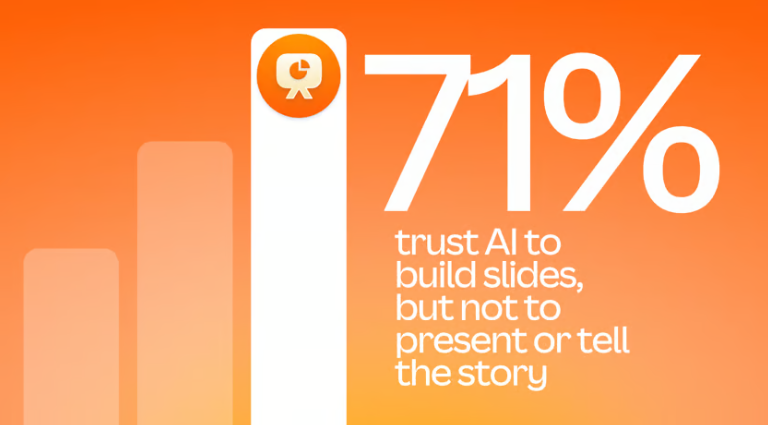
As AI use grows, we’re still figuring out where it helps and where we need to bring our whole selves into our work. We found half (51%) are happy to start every presentation with an AI draft, but when it comes to delivering it, things get more nuanced: 71% trust AI to build slides, but not to present or tell the story, and 86% say great presentations still come down to human connection.
When presentation nerves create an alter ego
Holding people’s attention isn’t easy, especially when we’re used to presenting behind a screen.
If public speaking makes you feel sick to your stomach, you’re not alone. Even with AI, three in four (74%) get nervous presenting. I remember preparing for a TED talk and being terrified I’d forget my lines. A coach told me to stop obsessing over the script and practice with just the visuals instead. It brought more of my personality into it, and made it feel more like a conversation than a performance.
Most people (85%) say they deal with nerves by slipping into a “Presenter Persona” where they change their voice or body language to come across more confidently. It’s mostly seen among younger professionals: 94% of Gen Z and 90% of Millennials say they do it, compared to 70% of Boomers. I think it can be a bit of armour when you’re still finding your voice at work or looking to prove yourself.
Years of remote work play a part too. With fewer chances to practice presenting, more than a third (34%) say remote work has left them feeling out of practice and more than half (51%) feel more confident presenting behind a screen. That increases to 62% of Gen Z, compared to 32% of Boomers.
Presentation skills are becoming career currency
As AI makes it easier for anyone to whip up polished slides, it levels the playing field on design, but raises the bar for shaping a strong narrative and delivering it with confidence. More than two-thirds (68%) say an AI-built deck can hurt a presentation if the delivery doesn’t match. If the speaker is unprepared, reads from the screen or can’t explain their ideas clearly, the gap becomes obvious. Presenting is a chance to show not only how you think, but how you lead. Can you stay calm under pressure and bring people along with you? These are skills teams look for, with 54% saying strong presentation skills can signal leadership potential.
People who present their ideas convincingly are also getting noticed and earning trust, with 77% saying it has helped them grow their careers in the past year. Specifically, 68% link their presentation skills to a recent promotion or pay rise, and 77% say it has opened the door to more high-stakes work.
As these skills become more critical, our AI presentation tools are designed to support the whole process, from the spark of an idea to designing visual slides and feeling more prepared to present.
Anyone can create and edit presentations through a simple conversation with Canva AI. When it’s time to present, AI speaker notes help create talking points, timing insights keep you on track, and the remote control lets you engage your audience freely.
AI’s next act: from slide builder to presentation coach
The same thing raising the bar is also helping people meet it. AI is moving beyond building slides to helping us practice presenting too. More than half of us (53%) use AI as a presentation coach, getting feedback on drafts (45%), anticipating audience questions (41%), and even role-playing a boss (28%).
Some of us want AI to play an even bigger role: 65% would take prompts through an earpiece, and 55% would let an AI avatar give a presentation for them.
As the technology evolves, I’m interested to see how far we let AI into the room. Some may let an avatar take the stage; others will keep it on the sidelines. But one thing won’t change: we still craft and deliver the story. AI should support the presenter, not the other way around.
For more information on how to access Canva Presentations within our all-in-one Visual Suite, visit www.canva.com/canva-business/
This press release has also been published on VRITIMES