Why Most SMEs Are Trapped in Price Wars, And How Category Creation Can Break the Cycle
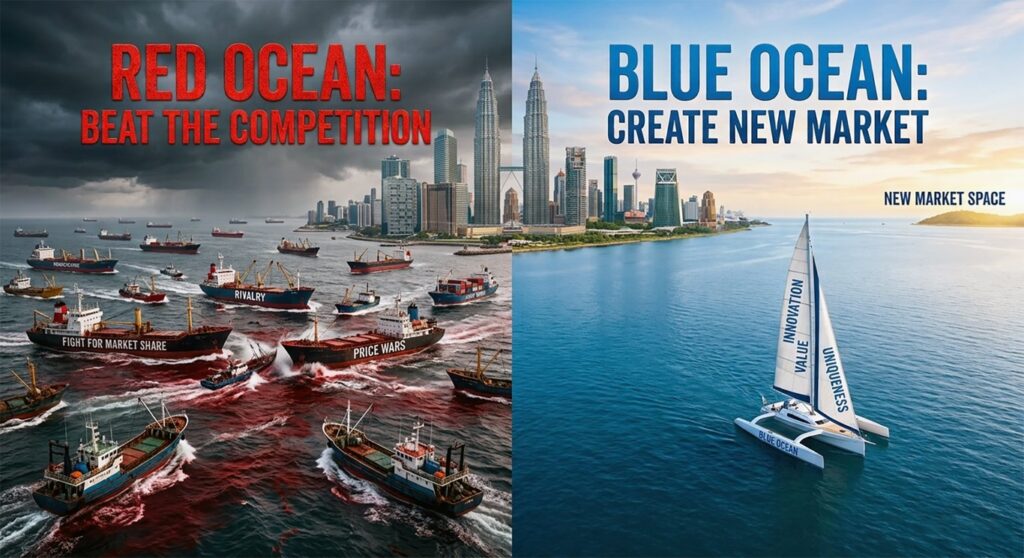
Malaysia’s real business crisis isn’t weak marketing. It’s too many brands competing without a clear reason to be chosen.
For many Malaysian SMEs, the instinctive response to slowing sales is familiar: launch another promotion, reduce prices, increase advertising, or match what competitors are doing.
It may generate short-term revenue.
But it rarely creates long-term growth.
Across industries such as food manufacturing, retail, automotive, engineering and consumer products, businesses are investing more in marketing than ever before. Yet many continue to face shrinking margins, rising customer acquisition costs and increasingly aggressive competition.
The pattern is remarkably consistent.
Products improve.
Marketing activity increases.
Competition intensifies.
Prices fall.
Margins shrink.
The Structural Reality Behind Malaysia’s SME Price Pressure
This is not anecdotal. It is reflected in national and regional data.
According to SME Corp Malaysia’s SME Annual Report, SMEs account for over 97% of all business establishments and contribute approximately 38% of GDP, yet productivity and value-added per firm remain significantly lower than regional leaders such as Singapore.
Meanwhile, Bank Negara Malaysia (BNM) has repeatedly highlighted in its Annual Report and SME Financing Review that SMEs face persistent challenges including:
• High market fragmentation
• Limited pricing power in competitive sectors
• Heavy reliance on cost-based competition
• Low brand differentiation in domestic markets
Regional consumer research from Google, Temasek & Bain (e-Conomy SEA Report) further reinforces this trend, noting that Southeast Asian SMEs increasingly compete in “hyper-competitive digital marketplaces where price transparency accelerates margin compression.”
In simple terms:
When customers can compare everything instantly, undifferentiated brands are forced into price competition.
This is the structural root of Malaysia’s SME pricing pressure.
Independent Industry Validation: What SME Leaders Are Observing
This challenge is widely acknowledged across Malaysian business ecosystems.
• The Federation of Malaysian Manufacturers (FMM) has consistently reported that manufacturers face “intensifying price competition in both domestic and export markets, particularly in commoditised product categories.”
• The SME Association of Malaysia has highlighted that many SMEs struggle to “move beyond transactional competition into brand-led value creation.”
• Export development programmes under MATRADE frequently emphasise that Malaysian SMEs often lose regional bids not due to product quality, but due to “insufficient brand differentiation and unclear positioning.”
Across these independent sources, a consistent theme emerges:
Malaysian SMEs are operationally strong, but strategically under-positioned.
The Real Issue: Interchangeability, Not Capability
The issue is not that Malaysian businesses lack quality products or entrepreneurial ambition.
The issue is that too many brands remain interchangeable in the eyes of customers.
When buyers struggle to understand why one company is meaningfully different from another, purchasing decisions inevitably become driven by price.
That is the differentiation crisis facing many businesses today.
Ironically, Malaysia has never had greater opportunities for growth. Through ASEAN integration, RCEP and CPTPP, businesses now have access to significantly larger regional markets than ever before. Yet greater market access does not automatically translate into stronger market positions.
Companies must first answer a more fundamental question:
Why should customers choose us instead of everyone else?
What High-Performing SMEs Do Differently
Research into high-growth SMEs across Southeast Asia (including findings from McKinsey’s SME Growth Studies and Google SME Digital Maturity research) shows a consistent pattern:
Businesses that outperform competitors rarely win through price efficiency alone.
Instead, they:
• Focus on category leadership rather than product competition
• Build distinct mental positioning in the customer’s mind
• Create new demand spaces instead of fighting existing ones
• Invest in brand meaning, not just brand visibility
In other words:
They do not compete to be cheaper. They compete to be incomparable.
Introducing the Category Hack Blueprint™ Framework
At Phoenix Design, this philosophy is structured into the Category Hack Blueprint™, a strategic system designed to help SMEs escape price-based competition and build defensible market positions.
The framework consists of four core stages:
1. Category Friction Mapping
Identifying where customers experience confusion, dissatisfaction, or unmet expectations in existing markets.
• What is frustrating customers in current categories?
• Where are competitors failing to deliver clarity or value?
• What assumptions in the market are no longer valid?
2. Demand Gap Discovery
Finding unmet or poorly served needs that existing competitors are not addressing.
• What do customers want but cannot clearly find?
• What is being over-served or under-served?
• Where is value being misunderstood or undervalued?
3. Category Definition
Reframing the business from a product provider into a category creator.
• Defining a new “mental space” in the customer’s mind
• Establishing a clear “why we exist” beyond product features
• Creating a new standard of comparison
4. Market Encoding & Adoption
Embedding the new category into the market through consistent messaging, storytelling, and cultural alignment.
• Aligning brand narrative across channels
• Educating the market on the new category logic
• Building early adopter credibility and authority
The goal is not incremental differentiation.
It is category ownership, where competitors are no longer direct comparisons.
Case Studies: When Category Creation Changes Growth Trajectories
Case Study 1: Regional Food Manufacturer (Malaysia → ASEAN Expansion)
A mid-sized Malaysian food manufacturer was competing in a saturated packaged food category with declining margins and heavy retailer price pressure.
Before repositioning:
• Annual growth: ~3–5%
• Gross margin: declining due to retailer pressure
• Competing on price promotions
After category repositioning: The business was reframed from a “food manufacturer” to a “heritage ingredient experience brand” targeting premium ASEAN retail channels.
Results within 18 months:
• Entry into 3 new ASEAN markets
• 27% increase in average selling price
• Shift from promotional sales to brand-led distribution
• Improved retailer negotiation leverage
Case Study 2: Industrial Engineering SME (Malaysia)
A B2B engineering firm was competing purely on tender pricing in a commoditised procurement environment.
Before:
• Win rate: ~18% of tenders
• Competing against lowest-cost providers
• No brand differentiation in procurement decisions
After category creation: Repositioned as a “precision uptime engineering partner” focusing on operational reliability rather than equipment supply.
Results:
• Win rate increased to 34%
• Shift from price-based tenders to consultative engagements
• 2 long-term service contracts secured (multi-year recurring revenue)
Case Study 3: Consumer Lifestyle Brand (Southeast Asia)
A lifestyle SME selling in multiple ASEAN markets struggled with inconsistent branding and low repeat purchase rates.
After applying Cultural Compass™ + category repositioning:
• Unified brand narrative across 4 markets
• Localised messaging based on cultural buying behaviour
• Shift from product-led to identity-led branding
Results:
• 2.3x increase in repeat purchase rate
• 41% improvement in customer retention
• Stronger performance in Singapore and Thailand markets
Why Category Creation Works in ASEAN Markets
Category creation is particularly powerful in Southeast Asia because:
• Markets are fragmented but fast-growing
• Consumers are highly brand-sensitive but value-conscious
• Digital platforms increase price transparency
• Cultural differences create localised perception gaps
This means:
The first brand to define meaning often becomes the default reference point.
Beyond Category Creation: The Role of Cultural Intelligence
Creating a category is not enough if it does not translate across markets.
ASEAN is not a single homogeneous market.
Consumers in Kuala Lumpur, Singapore, Jakarta, Bangkok and Ho Chi Minh City may share economic aspirations, but their purchasing behaviour is influenced by different cultural expectations, trust signals, and decision-making patterns.
This is why localisation must go beyond translation.
Phoenix Design’s Cultural Compass™ framework helps businesses:
• Decode cultural drivers of trust and value perception
• Adapt messaging without losing brand consistency
• Align category positioning with local market psychology
Together, Category Hack Blueprint™ and Cultural Compass™ form a dual system:
One defines what you are in the market. The other defines how you are understood across markets.
Leadership Perspective
During our initial months establishing Phoenix Design’s presence in Kuala Lumpur and meeting business owners across the Klang Valley, one observation became increasingly clear.
Malaysia is not short of capable businesses.
It is short of businesses that clearly communicate why they are different.
“One of the most encouraging things we’ve observed since entering Kuala Lumpur is the depth of expertise that already exists within Malaysian businesses,” said Herry Ho, Founder and Managing Director of Phoenix Design.
“Whether in manufacturing, engineering, retail or food production, many companies have the capability to compete across ASEAN. What often limits them is not product quality or operational excellence, but strategic positioning. When businesses stop asking how to compete on price and start asking what category they can own, they unlock entirely different growth opportunities.”
The Future of Malaysian Business Competition
The future of Malaysian business will not be defined by who discounts the most aggressively.
It will be defined by who creates the clearest market distinction.
In a region where customers have more choices than ever before, brands that merely participate in existing categories will continue to compete on price.
Brands that create new categories will shape customer expectations, command stronger loyalty and build sustainable growth across ASEAN.
The next generation of Malaysian business leaders will not win by becoming cheaper.
They will win by becoming impossible to compare.
This press release has also been published on VRITIMES