Philippine Automotive Outlook: Competing With ASEAN Production Hubs in an Era of EVs and Smart Vehicles
The Philippine automotive industry operates within one of the world’s most important vehicle-production regions. Thailand has developed a global reputation for pickup trucks and automotive exports, while Indonesia has built large-scale production around multipurpose vehicles, compact models, and a growing electric vehicle supply chain.
Regional production and sales information published by the ASEAN Automotive Federation illustrates the significant differences in manufacturing scale among Southeast Asian markets.
The Philippines has a large consumer base, but vehicle demand does not automatically translate into local production. Many of the most popular models sold in the country are imported from factories elsewhere in ASEAN, where manufacturers already benefit from mature supplier networks and high production volumes.
To remain relevant, the Philippines must identify segments where local knowledge, workforce capability, and domestic demand create a genuine advantage.
Competing on Volume Alone Is Unrealistic
Building another large passenger-car factory does not guarantee success. Manufacturers must be confident that a plant can achieve sufficient production volume over many years.
Thailand and Indonesia already possess extensive networks of component suppliers located near assembly plants. Reproducing those ecosystems would require substantial investment and long-term policy consistency.
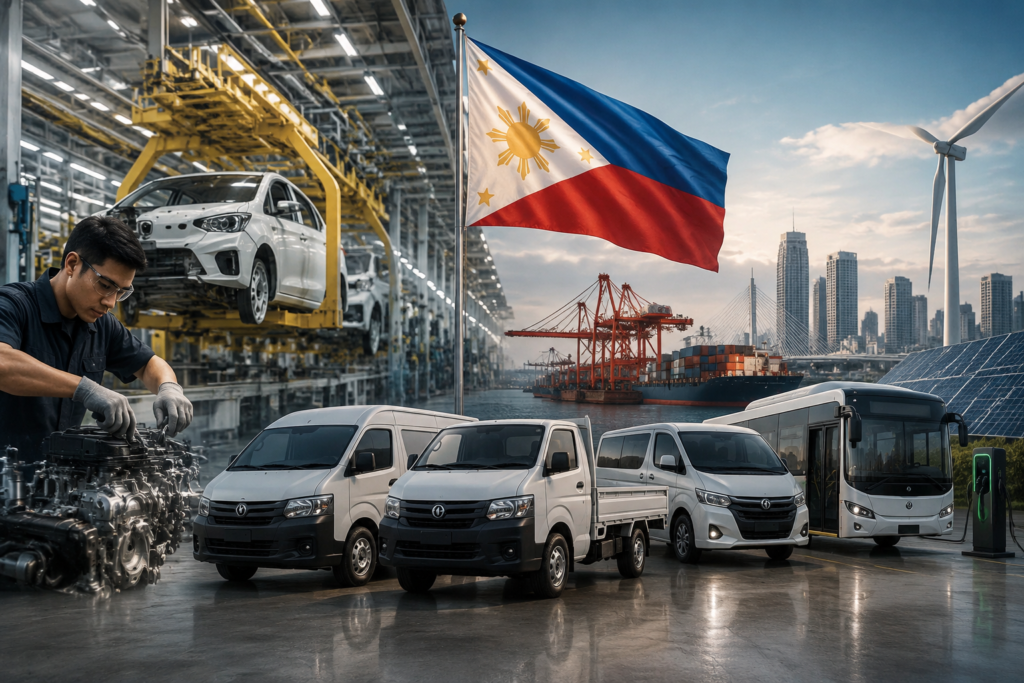
A more practical Philippine strategy would focus on specialized vehicles and components rather than attempting to replace every imported model. Commercial utility vehicles, electric public transport, motorcycles, automotive electronics, and vehicle customization offer stronger possibilities.
Locally assembled vehicles can also serve sectors with distinctly Philippine requirements, including intercity transport, agricultural logistics, tourism, disaster response, and last-mile delivery.
Chinese EV Brands Are Accelerating Competition
The arrival and expansion of Chinese automotive brands have changed the market. These companies often introduce electric and hybrid vehicles with competitive pricing, large infotainment displays, advanced driver-assistance systems, and extensive standard equipment.
Traditional Japanese, Korean, American, and European manufacturers must now respond more quickly. Consumers increasingly expect digital features and efficient powertrains even in mainstream vehicles.
For Philippine industry, this creates both pressure and opportunity. Imported electric vehicles could reduce the market share available to locally assembled conventional models. At the same time, growing EV demand may attract investment in charging equipment, fleet services, battery diagnostics, software, and component production.
Policy Stability Will Influence Investment Decisions
Automotive factories require long planning horizons. Manufacturers must evaluate taxes, import rules, energy costs, labor availability, infrastructure, and incentives before committing capital.
Frequent policy changes make investment more difficult because vehicle programs often remain in production for a decade or longer. The Philippines needs predictable rules covering local manufacturing incentives, electric vehicles, charging infrastructure, technical standards, and component imports.
Environmental objectives must also be aligned with industrial policy. Encouraging EV purchases without developing local capabilities could increase imports without creating substantial manufacturing value.
A Specialized ASEAN Role Is Still Achievable
The Philippines does not need to surpass Thailand or Indonesia in total production to build a successful automotive industry. It can occupy a focused role within regional supply chains.
The country’s electronics sector could supply sensors, control modules, wiring systems, and power-management components. Local body builders could produce specialized commercial vehicles. Engineering and software companies could support fleet management, connected mobility, and charging networks.
Future competitiveness will be measured not only by the number of vehicles assembled, but also by the value of Philippine technology, labor, and components used across the regional automotive market.
A strategy centered on specialization, reliable infrastructure, technical education, and stable policy would give the Philippines a more realistic path toward sustainable automotive growth.