Scarcity as a Design Constraint: Planning Within a Finite Island
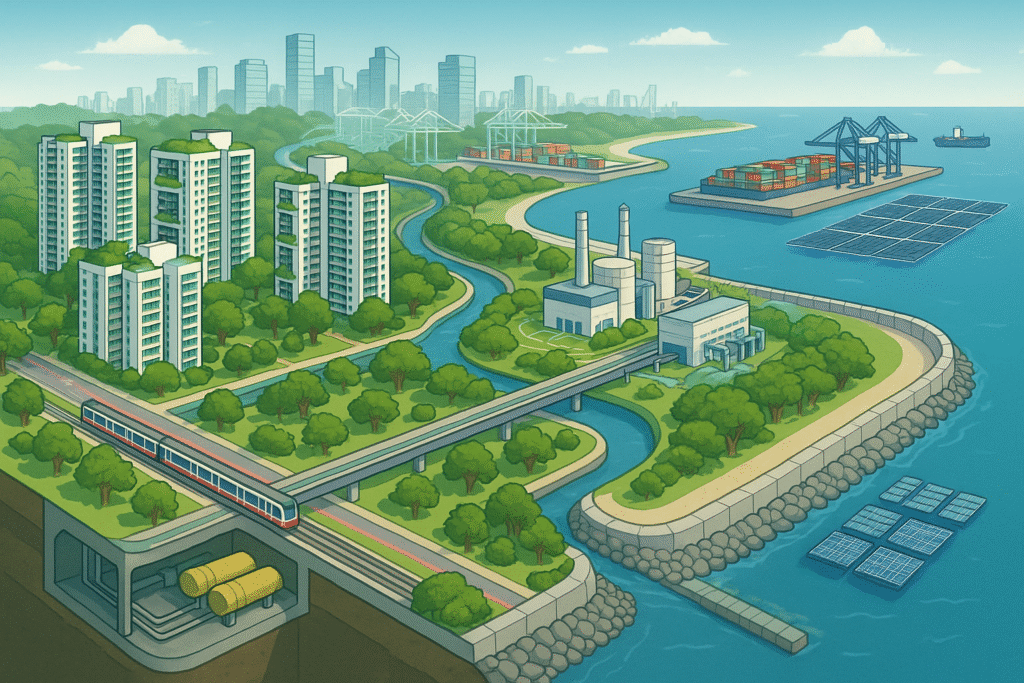
Singapore’s development story is a masterclass in designing within hard boundaries. With limited land and almost no extractive resources, the city-state treats every square meter as strategic infrastructure. Instead of spreading outward, it builds upward, downward, and inward—compressing functions and sequencing them over time so the same parcel can serve different roles across decades. This mindset reframes scarcity from a shortfall into a design brief.
The first principle is intensity with livability. High-rise, high-quality housing districts are planned as complete neighborhoods where schools, clinics, markets, parks, and transit coexist within a fifteen-minute radius. Plot ratios are calibrated to match rail capacity, so people can live dense without overwhelming the network. Car-lite policies conserve road space for essential movement; parking is rationed and priced, while sidewalks are widened, shaded, and made more continuous to favor walking and cycling.
The second principle is layered land use. Programs are stacked vertically (residential over retail, over transit, over services) and also pushed underground. Utility tunnels, stormwater conduits, waste conveyance pipes, and even oil storage caverns migrate below ground to free surface land for homes and public spaces. Where possible, infrastructure is placed at the coast or on man-made extensions, reserving central districts for people-centric uses. Co-location is deliberate: data centers cluster with substations; industrial estates share logistics nodes; schools anchor community facilities.
The third principle is sequencing. When a port consolidates, waterfront tracts are re-parceled for housing, offices, and parks; when a rail line opens, surrounding plots are intensified; when older estates age, rejuvenation upgrades greenery, ventilation, and accessibility. Long-range plans preserve corridors for future lines and utilities, avoiding costly retrofits. Digital twins and scenario tools are used to test trade-offs precisely because any misstep consumes irrecoverable land.
Ecology is integrated, not ornamental. Nature reserves and blue-green networks are safeguarded despite their opportunity cost because they deliver cooling, flood mitigation, and biodiversity. Microclimate is treated as infrastructure: canopies shade pavements, breezeways align with prevailing winds, and permeable surfaces allow rain to soak and evaporate. These details matter in a tropical, compact city where thermal comfort, not just floor area, defines livability.
All of this is underwritten by governance. Transparent land-use guidelines, consistent zoning, and cross-agency coordination enable trade-offs to be made openly and updated as needs shift. The social compact is crucial: residents accept density when it is matched by reliable transit, accessible amenities, and dignified public space. In a context of finite land and scarce resources, planning is less about drawing boundaries and more about choreographing time, layers, and value.